
Important piece of Health Service Improvement research begins
An important new piece of research about the best ways to incorporate patients and service users鈥� opinions to improve the Health Services has begun in earnest at 精东传媒 this week.
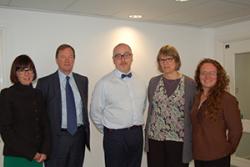 Dr Chris Burton (centre) with Prof Jo Rycroft-Malone (l) and Dr Nicky Callow (r), with Bill Lucas and Fiona Reed of the Health Foundation at an inaugural research meeting.Dr Christopher Burton, a Senior Research Fellow with the at 精东传媒, was awarded a prestigious Health Foundation Fellowship. The three year award will now see him working with a team of improvement scientists, researching up to 10 improvement projects across the UK, to learn how improvements work, and what is effective in delivering the desired impacts for organisations, staff and patients. The overall aim will be to create better outcomes for patients.
There are many improvement projects across the UK, and much of the research by improvement scientists into their effectiveness, looks at different strategies adopted to improve performance.
What is new about Dr Burton鈥檚 approach is that he is interested in studying the effect of Patient and Public Involvement (PPI) in health improvement projects. He aims to develop new skills and theoretical insights in improvement science, and to develop specialist expertise around patient and public involvement.
Because patients are central to healthcare, patient and public involvement is a component of nearly all improvement work, bringing information about experiences, preferences and the consequences of change. However, Chris thinks that so far PPI has received little attention from improvement science, and understanding more about it would be hugely beneficial to healthcare improvement.
鈥業鈥檓 focussing on improvement projects that include PPI which may develop very different resources and insights for health organisations. PPI is so interesting because it鈥檚 occurring in so many areas of improvement work, and we鈥檒l find there is an enormous amount of learning we can use to our advantage. It feels like it is a growing field of practice and I think the potential to develop science in this area is enormous.鈥�
鈥業 want to capture a rich picture of the influence that PPI has throughout the interplay of an organisation鈥檚 improvement work. Not just how it shapes a project, but the type of peripheral learning and feedback that it generates. I hope to show how tapping into this open resource can add significant value to an organisation鈥檚 improvement work, enhance the experience of the people involved in that work, and overall create better outcomes for patients.鈥�
Healthcare improvement work can encompass anything from infrastructure changes that support improvement, to organisational partnerships or changes to systems and practices. Chris will be planning this work with reference to a theory known as 鈥榯he resource based view of the firm鈥� which sees organisations as a complex mix of resources, including the experience and skills of their staff. He鈥檚 interested in how these resources are shaped by improvement work.
鈥楢ll organisations try to maximise the resources they have to increase their capacity to deliver high quality services. I鈥檓 trying to identify why organisations invest time and energy doing improvement work, and the value it adds to their organisation. By applying tested theory, I鈥檓 hoping to discover rational reasons about why improvement projects work,鈥� he explains.
Chris Burton holds a PhD in health sciences and is interested in how organisations go about improvement work 鈥� particularly when it comes to collaborating with patients and the public, and the kinds of pitfalls and successes experienced.
Publication date: 13 May 2013